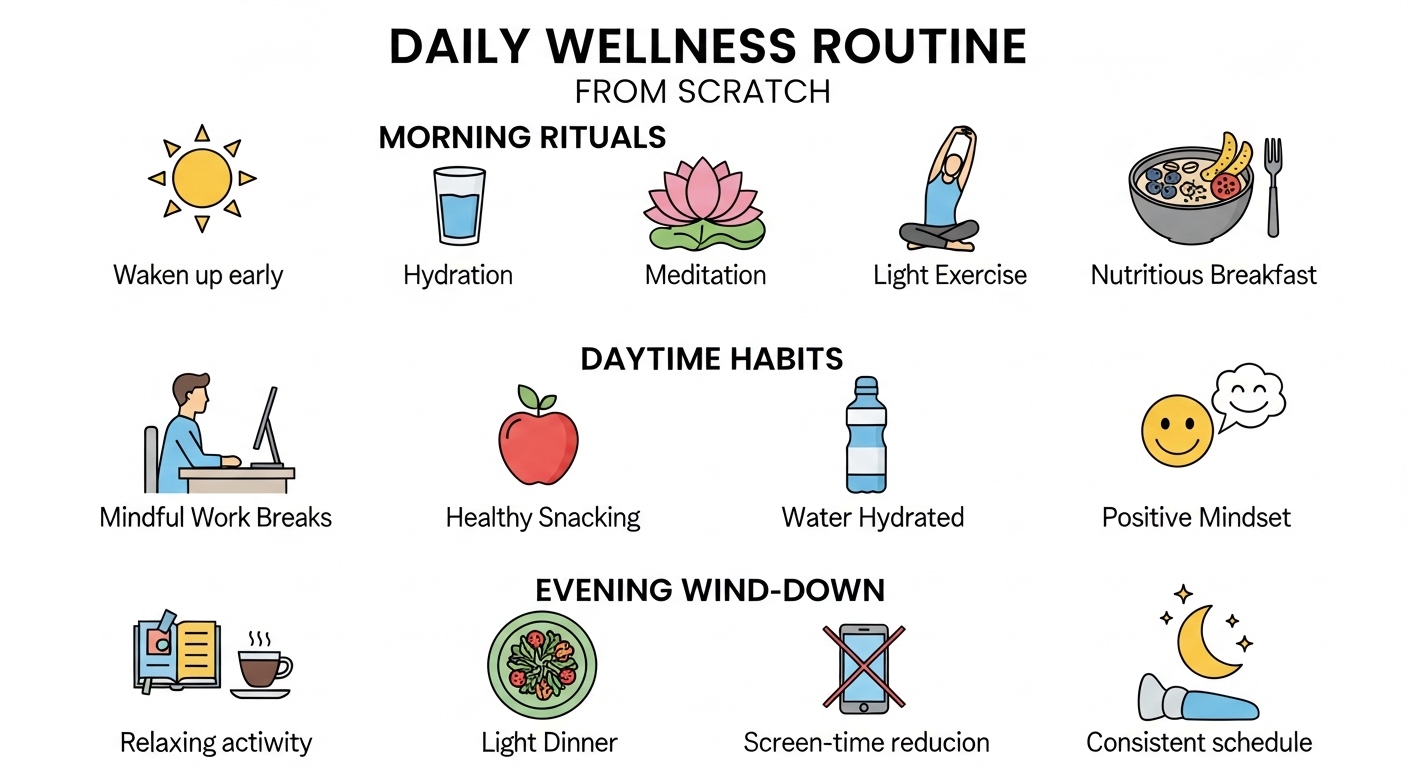
Most people try to improve their health by copying someone else’s routine. They wake up earlier, add workouts, drink more water, or meditate for five minutes. Then they quit within two weeks. Not because they are lazy. Because the routine never matched their life.
A daily wellness routine only works when it fits your schedule, energy level, responsibilities, and goals. Without structure, habits compete for attention. Without priorities, progress becomes random. Without consistency, motivation fades.
The solution is not discipline alone. It is design.
This guide shows exactly how to build a daily wellness routine from scratch using a practical framework that works for beginners and busy professionals. You will learn how to choose habits, structure your day, avoid burnout, and maintain consistency long-term.
What Is a Daily Wellness Routine and Why Does It Matter?
A daily wellness routine is a structured set of repeatable habits that support physical health, mental clarity, emotional stability, and energy management. It reduces decision fatigue, improves consistency, and helps your body and brain operate predictably, making long-term health progress easier and more sustainable.
A daily wellness routine improves health by organizing sleep, movement, nutrition, stress control, and recovery into predictable actions performed at consistent times. Instead of relying on motivation, routines automate healthy behavior, reduce mental effort, increase energy stability, and make long-term lifestyle improvements achievable even during busy schedules.
Most people misunderstand wellness routines. They assume routines must be complicated. In reality, effective routines remove complexity.
When your day has structure, your brain spends less energy deciding what to do next. This improves focus and reduces stress.
Research in behavioral psychology shows repeated actions performed in stable contexts become automatic over time. That means routines eventually require less effort than random decision-making.
A strong wellness routine supports:
Consistent sleep timing
Regular hydration
Daily movement
Balanced nutrition
Stress regulation
Mental clarity
Instead of chasing motivation, routines create stability. Stability creates progress.
How Do You Start a Wellness Routine From Zero?
Start by selecting three foundational habits: consistent wake time, hydration after waking, and 10 minutes of movement daily. These create momentum without overload. Once stable, add nutrition structure, stress management practices, and sleep improvements gradually to build a sustainable routine.
Most beginners fail because they attempt too many changes at once.
A better approach is stacking habits progressively.
Start with anchor behaviors. These influence multiple health systems at once.
The most effective starting structure includes:
Wake at the same time daily
Drink water within 10 minutes
Move your body for 10 minutes
These actions regulate circadian rhythm, hydration levels, and metabolism.
Once stable after one week, add:
Protein-rich breakfast
Midday walking break
Screen reduction before sleep
This layering strategy prevents overwhelm.
Consistency beats intensity during the first 30 days of routine building.
What Should Be Included in a Complete Daily Wellness Routine?
A complete wellness routine includes sleep scheduling, hydration timing, movement sessions, balanced meals, stress regulation practices, sunlight exposure, and digital boundaries. Together, these elements support energy stability, cognitive function, metabolic health, and emotional resilience throughout the entire day.
Many routines fail because they only focus on exercise.
Exercise matters. But wellness includes multiple systems working together.
Routine Element
Purpose
Impact
Sleep timing
Regulates hormones
Improves energy and recovery
Hydration
Supports metabolism
Enhances focus and digestion
Movement
Improves circulation
Boosts mood and strength
Nutrition
Stabilizes blood sugar
Maintains energy levels
Stress control
Reduces cortisol
Supports mental clarity
Sunlight exposure
Balances circadian rhythm
Improves sleep quality
Each component reinforces the others.
For example, better hydration improves exercise performance. Exercise improves sleep quality. Better sleep improves appetite control.
This creates a reinforcing cycle.
A complete routine works because systems connect.
How Long Should a Daily Wellness Routine Take?
An effective daily wellness routine can take 30 to 60 minutes total when distributed across the day. Short sessions of movement, hydration, structured meals, and stress management practices provide measurable health benefits without requiring large time commitments or major lifestyle disruption.
Time is the biggest barrier people report.
But routines do not require uninterrupted blocks.
Instead, distribute actions across your day.
Example structure:
Morning hydration: 2 minutes
Stretching or walking: 10 minutes
Meal planning: 5 minutes
Midday walk: 10 minutes
Evening wind-down: 10 minutes
This totals less than 40 minutes.
Consistency matters more than duration.
Even small routines improve:
Sleep cycles
Energy levels
Stress tolerance
Productivity
Short routines reduce resistance. Reduced resistance increases adherence.
What Does a Simple Morning Wellness Routine Look Like?
A simple morning wellness routine includes hydration, sunlight exposure, light movement, and protein intake within the first hour of waking. These actions activate metabolism, improve mental alertness, stabilize hormones, and prepare the body for sustained energy throughout the day.
Your morning routine sets your biological direction.
The first hour after waking influences cortisol rhythm, insulin sensitivity, and focus capacity.
A strong morning structure includes:
Drink one glass of water
Expose eyes to natural light
Stretch or walk for 5–10 minutes
Eat protein within one hour
These steps regulate circadian timing signals.
Skipping them often leads to:
Energy crashes
Poor appetite control
Reduced concentration
Late-night sleep disruption
A structured morning routine creates predictable daily performance.
How Do You Stay Consistent With a Wellness Routine Long-Term?
Consistency improves when routines are scheduled at fixed times, tracked visually, simplified into small steps, and connected to existing habits. Removing decision-making friction and measuring progress weekly helps routines become automatic instead of dependent on motivation.
Motivation fluctuates. Systems remain stable.
To maintain routines long-term, reduce complexity.
Use habit stacking.
Examples:
Drink water after brushing teeth
Walk after lunch
Stretch before shower
This links behaviors together.
Tracking also increases success rates.
Simple tools include:
Habit checklists
Wall calendars
Phone reminders
Weekly reviews
Consistency grows when routines become predictable parts of your environment.
What Mistakes Should You Avoid When Building a Wellness Routine?
The most common mistakes include adding too many habits at once, copying unrealistic routines, ignoring sleep timing, relying on motivation instead of scheduling, and expecting immediate results. Avoiding these errors increases routine sustainability and prevents burnout during the first 30 days.
Many routines fail before they begin.
Failure usually follows predictable patterns.
The biggest mistake is copying influencer routines.
Those routines often assume:
Flexible schedules
Low stress environments
Access to equipment
High baseline fitness
Instead, design routines around your real life.
Another mistake is expecting fast results.
Behavioral change research shows habit automation typically takes several weeks.
Focus on stability first. Results follow consistency.
How Can You Build a Personalized Wellness Routine That Fits Your Lifestyle?
A personalized wellness routine matches your wake time, work schedule, energy patterns, and health goals. Start by identifying high-energy periods, selecting realistic habit durations, and adjusting routines weekly based on feedback to create a flexible system that evolves with your lifestyle.
Personalization determines success.
Morning routines work well for early risers. Evening routines work better for night-focused workers.
Start by identifying your strongest energy window.
Then schedule movement inside that window.
Next, design nutrition timing around work demands.
Example personalization strategy:
Identify energy peak hours
Schedule movement there
Fix sleep timing
Add hydration anchors
Insert stress breaks
Review your routine weekly.
Adjust based on:
Fatigue levels
Focus changes
Sleep quality
Workload variation
Flexible routines last longer than rigid systems.
Conclusion: Build a Routine That Works Even on Busy Days
A daily wellness routine does not need perfection. It needs structure.
Start with three anchor habits. Add supporting behaviors gradually. Track consistency weekly. Adjust based on energy and schedule.
When routines match your lifestyle, they stop feeling forced. They become automatic.
The most effective routines include sleep timing, hydration, movement, nutrition structure, and stress regulation. Together, these create stable energy and predictable performance.
Instead of chasing motivation, build systems that support your health every day.
Start today by choosing one habit to repeat tomorrow morning. Then repeat it again the next day. Small actions create lasting change.
Your routine does not need to be perfect. It needs to exist.
Frequently Asked Questions
How long does it take to build a wellness routine?
Most people begin stabilizing routines within two weeks, but full habit automation typically takes four to eight weeks depending on complexity, consistency, and lifestyle factors. Starting with fewer habits improves long-term success.
Can I build a routine without exercising daily?
Yes. Movement improves wellness, but routines can begin with hydration, sleep timing, and nutrition structure. Adding short walking sessions later still provides strong physical and mental health benefits.
What is the best time to start a wellness routine?
The best time is when your schedule is stable for at least five consecutive days. Starting during predictable weeks improves adherence and reduces routine disruption during early habit formation.
Should I follow the same routine every day?
Core habits should remain consistent daily, but activity intensity and duration can change. Flexible routines adapt to workload and energy variations while preserving structure.
Do wellness routines improve productivity?
Yes. Structured routines reduce decision fatigue, stabilize energy levels, improve sleep quality, and increase focus capacity, which directly supports productivity across professional and personal tasks.
What is the minimum effective wellness routine?
A minimum routine includes consistent wake time, hydration after waking, and 10 minutes of daily movement. These three habits improve metabolic rhythm and create momentum for adding advanced habits later.
Can busy professionals maintain wellness routines?
Yes. Distributing habits across the day in short sessions allows routines to fit demanding schedules. Consistency matters more than duration for long-term health improvement.